One fifth of France
On August 17 OpenAI signed a lease for a data center campus in Pike County, Ohio. SB Energy (a SoftBank company) builds and owns it, Nvidia supplies every chip in it, and Nvidia guarantees up to $105 billion of OpenAI's lease and power obligations in case OpenAI can't pay. 3 weeks earlier, the number being discussed was $250 billion.
$105 billion, $250 billion, 8 gigawatts, an $852 billion valuation for a company that loses money. None of these numbers mean anything on their own.
It's all abstract.
So let's convert them.
The money goes in a circle
Vendor financing is when the seller lends the buyer the money in order to buy the seller's product. That's the neutral definition, and it's a normal tool: car makers do it, equipment makers do it, and most of the time everyone gets paid.
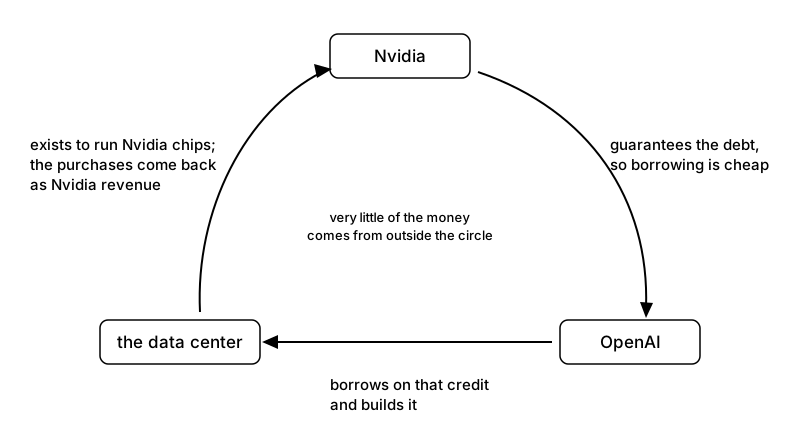
Now, here's the loop in this specific deal. Nvidia guarantees OpenAI's obligations, which lets OpenAI borrow cheaply on the strength of Nvidia's credit. The borrowed money builds a data center whose only purpose is to run Nvidia chips. The chip purchases become Nvidia revenue, the revenue supports Nvidia's stock, and the strength of that stock is what makes the guarantee look safe in the first place. Nvidia is also reportedly discussing a separate arrangement to finance OpenAI's chip purchases themselves, up to $350 billion across the full project.
Follow the money around the circle and you notice something: very little of it comes from outside. The customer's ability to buy depends on the seller's credit, and the seller's credit depends on the customer's buying.
That's the whole trick.
Nobody converts the numbers
However, the money numbers aren't even the strange part. The power numbers are.
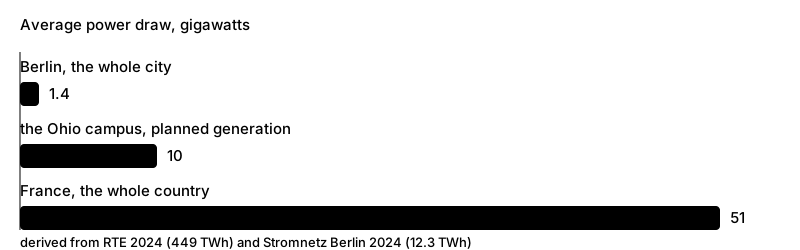
The campus is designed for 8 gigawatts of computing, which needs about 10 gigawatts of new generation, most of it gas. Gigawatts are abstract too, so let's keep converting. France, the whole country (nuclear plants, trains, factories, 68 million people), consumed 449 TWh of electricity in 2024. Spread over the year, that's an average draw of about 51 gigawatts.
One campus in Ohio: about a fifth of France.
Berlin, the whole city (homes, offices, factories, the U-Bahn, 3.9 million people), used 12.3 TWh of electricity in 2024. This single site, running flat out, would burn through almost 6 times that. One building complex, 6 Berlins, and it's the first of many being announced.
When someone quotes you a billion-dollar figure, you shrug, because there's nothing to compare it to. When someone tells you a company borrowed a fifth of France to run chatbots, you at least know what's being spent.
The bears keep being wrong
I have to concede the strongest point against me: every crash call on AI since 2023 has been wrong. The earnings were real, the margins were real, and the people who shorted this got carried out. Being early and being wrong pay out exactly the same. If you'd listened to the bears at any point in the last 3 years, you'd be poorer for it.
That being said, we've seen this exact structure before, and I don't mean "the internet in 2000" in the vague way people usually mean it. I mean the specific debt structure. In the late 90s, telecom equipment makers lent their own customers the money to buy their equipment: Lucent committed $8.1 billion, Cisco $2.4 billion, and McKinsey later put the combined exposure of 9 suppliers at about $25.6 billion by the end of 2000. When the banks got nervous, the vendors kept lending, because by then their own stock prices depended on those customers surviving.
Lucent's bad loans went from 2.6% of its loan book to 60%. Nortel's went from 25.5% to 80%. Lucent never recovered; it was sold off in 2006.
Notice where we are in that sequence. Nvidia's own investors already forced the guarantee down from $250 billion to $105 billion. That's the "banks getting nervous" step, happening in public, before the campus is even built.
So yes, I'm calling it: this crashes. I don't know when, and I won't pretend to. The bears will keep being wrong right up until the day they aren't, and the mechanism (a seller underwriting its own demand, at 4,000 times the telecom scale) doesn't care about the date. This post is the timestamp.
What doesn't come back
That was a lot of numbers for something I planned as a short post!
Here's the part I keep coming back to. When the telecom loop stopped turning, the damage was mostly paper: loans got restructured, forgiven, rolled over or written off, and 20 years later nobody misses them. Money in a circle can unwind.
The power can't. The 10 gigawatts get generated whether the loans perform or not, most of it from gas, drawn out of the environment a fifth-of-France at a time, campus after campus. If the bet works, we burned it for a machine that answers emails. If the bet fails, we burned it for nothing.
When this loop stops turning, who do you think eats the loss: the guarantor, the borrower, or the air?
The money will find its way back. The gas won't.