Drop the word artificial
Artificial, from the Latin artificialis, means made by human craft. A thing produced by skill instead of grown on its own: a canal, a fibre, a sweetener. The word carries no accusation in it, it only tells us where something came from.
Somewhere in the last decades we inverted it. Artificial came to mean the opposite of us, and we attached a mild suspicion to it: cold, and arriving from somewhere outside.
Then two weeks ago a chatbot arrived and we called it artificial intelligence.
Here's what it's made of: pages crawled from the open web across several years, links that people shared on forums, 2 large collections of books, and the whole of Wikipedia. Nobody was asked. It was taken, at no cost, because it was sitting in the open and there was nothing in the way.
There's nothing artificial in there. It's us, compressed.
Now that we've defined the thing, here's what I'm thinking:
It's incredible, and it's neither of the 2 words in its name.
the wrong door
Let's be fair to the debate first. The question everybody is asking (does it understand, is it reasoning, is it conscious) is a real question, and the people asking it are serious people. Something happened here that hadn't happened before: a million people used it in 5 days, and a lot of them came back the next morning.
However, that debate is free entertainment, and it will run for years without resolving. It stays abstract, and I've started to think that's exactly what it's for.
Because while we hold it, nobody examines the transaction.
The transaction is simple. We get fluency, and it gets everything typed into it. OpenAI says as much in its own announcement: conversations may be reviewed by trainers in order to improve the system.
No offense intended; there are many people building these systems who understand them far better than I do, and I have no business criticizing them.
That being said, the strongest objection to all of this is one I'd raise myself. A confident wrong answer is not a new occurrence. Experts have produced them for as long as there have been experts, and we've built entire structures to survive that: citations, institutions, reputations or liability. Given that we already live with confidently wrong humans, why would confidently wrong software be different?
So what actually changed?
A signal that costs nothing
The logic goes as follows:
- Producing a plausible answer used to cost time and a reputation that someone could damage. Now it costs a fraction of a second and nothing else.
- Checking an answer costs exactly what it always did.
- As a result, the volume of unchecked answers grows against a checking capacity that doesn't move.
- Because checking is the expensive half, it's the half that gets skipped.
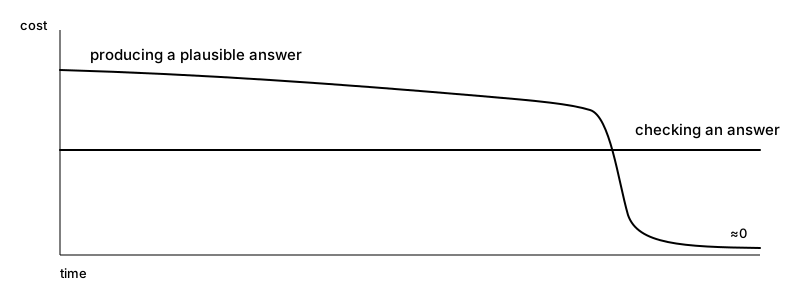
Fluent, well-structured text used to be an expensive signal. It meant someone had done the reading, or at minimum had spent the afternoon on it. That's why it was trusted, and the trust was never really about the prose.
Now the prose costs nothing, and the reading behind it is optional.
Stack Overflow measured this in 5 days and banned the answers outright. Their stated reason is the most precise sentence written about this technology so far: the answers have a high rate of being incorrect, and they typically look like they might be good.
Us, compressed
Now the second part, and this is the one I keep returning to.
The open web was taken for free and came back as a product. That alone would be an old story, because it happens to everything that's left out in the open.
But the crawl was the crude version. Because we're all typing into it now, the next round of raw material is being collected with our help, and this round is very much better than crawling: it's labelled, and it shows what we actually wanted to ask. Our confusions, our half-formed problems, the things we didn't know well enough to search for properly.
They've found a new and more effective way to mine us, and we queued up for it.
There's a lot more to say about what the thing is actually worth in practice, and I use it myself, but this article is getting long enough already!
I find it fascinating how much work a single word can do. Artificial tells us that something came from outside, and we reach for it exactly when we'd rather not look at where a thing actually came from. It's a very convenient word.
Drop it, and what's left is you: compressed, sold back, and still paying the next instalment.