Define the exit first
An exit, from the Latin exitus, is the act of going out. In trading it's the transaction that ends a position: the sell after the buy, the cover after the short. By definition it's also the only moment where anything real happens to your account, because until you exit, the profit or the loss is a number on a screen with an opinion attached.
Nobody frames it that way. The entry carries all the romance (the analysis, the timing, the "perfect" setup), and the exit carries all the feelings we'd rather not deal with: regret, apprehension, relief, occasionally shame.
We enter with the head and leave with the stomach.
Now that we've defined the thing, here's what I'm thinking:
A position without a predefined exit isn't a trade. It's a hope.
The perfect entry
Let's be fair to the orthodoxy first. The textbook says the entry is where the edge lives, and the textbook has a point. A good entry buys you room: a better price, a cleaner structure, more ways to be wrong and still survive. Because we entered well, we can sit through noise that would shake out a worse price. That's real, and I'll grant it fully.
I spent years studying entries. Indicators, structures, confluences of 4 or 5 signals at once, in order to find the one moment where a position starts "right".
However, here's what those years actually produced: winners I gave back to the market because leaving was never defined, and losers I nursed with very creative reasons for why tomorrow would be different. The entries were fine. Fine entries, both instances.
The problem was never the door in.
the mirror
So why do we study the wrong door? My answer is uncomfortable: because studying exits means studying ourselves, and nearly all of us would rather study the market.
The logic goes as follows:
- At the entry, we judge the market. We're flat, we have no number on the screen, and our reading is as clean as it will ever be.
- The moment the position opens, a number appears. From then on we aren't judging the market anymore, we're judging our own number, and every chart pattern conveniently rearranges itself around it.
- Fear switches sides. Before the entry, fear worked for us: it kept us out of bad ideas. Inside the position it works against us, holding the losers (fear of admitting) and dumping the winners (fear of giving back).
- As a result, the one decision that determines all outcomes is made by the least reliable version of ourselves.
Studying entries is studying price. Studying exits is studying your own behavior with money on the line, and that mirror is not flattering. No offense intended; there are many traders who exit brilliantly on pure discretion, and I have no business criticizing them.
For the rest of us, the attention is very unbalanced - balanced being half.
Leaving on light
Nature solved this a long time ago. A migratory population (A) doesn't leave the feeding grounds when the food runs out. It leaves when the days get shorter. The signal is defined in advance, external, and completely indifferent to how good the feeding currently feels. A population that instead waited for scarcity would be competing with every other organism (B) reacting to the same scarcity, departing weakened and arriving late.
The birds that feel their way out don't make the crossing.
Now, using that concept, let's return to trading. The equivalent of leaving on light is deciding the exit before the position exists, while we're still the clean version of ourselves from step 1. Remember the saying, "plan the trade, trade the plan"? Everyone quotes it and almost nobody notices that the plan is 90% exit.
In practice I use 2 mechanisms, and they're both defined before the entry:
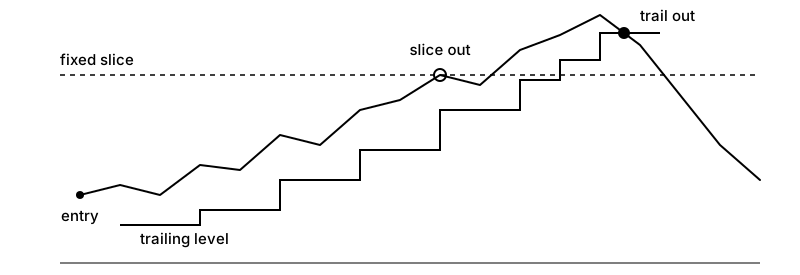
- A fixed slice of profit, taken and gone. This is "Profit Management": we restrict the amount we extract, the way you'd harvest without exhausting the ground.
- A trailing level that approaches the price as the price moves away from it. The further the move goes, the less room we give back. Early on, the position gets space to breathe; by the time the profit is large, the level sits close behind it, because a large profit is exactly when the number on the screen starts doing the thinking.
Because both levels existed before the position did, the open P&L has no vote. When price touches the level, we're out. No meeting, no negotiation.
Below an abstract instance of the two exits on the same move of XYZ: the slice leaves at a fixed point, the trail follows and tightens, and neither of them asks how we feel.
Enough, defined upfront
There's a lot more to say about sizing under trailing exits, but this article is getting long enough already!
I find it fascinating how well this transfers outside the charts. A job, a project, a habit or a commitment: we enter all of them with clean judgment and then hand the leaving decision to the version of ourselves that's already inside, attached, and reading its own number. The equilibrium is the same as in the market. Deciding what "enough" looks like before you're in is the only time you'll ever decide it honestly.
Before you enter anything, write down what leaving looks like. If you can't write it, then you aren't entering. You're hoping.